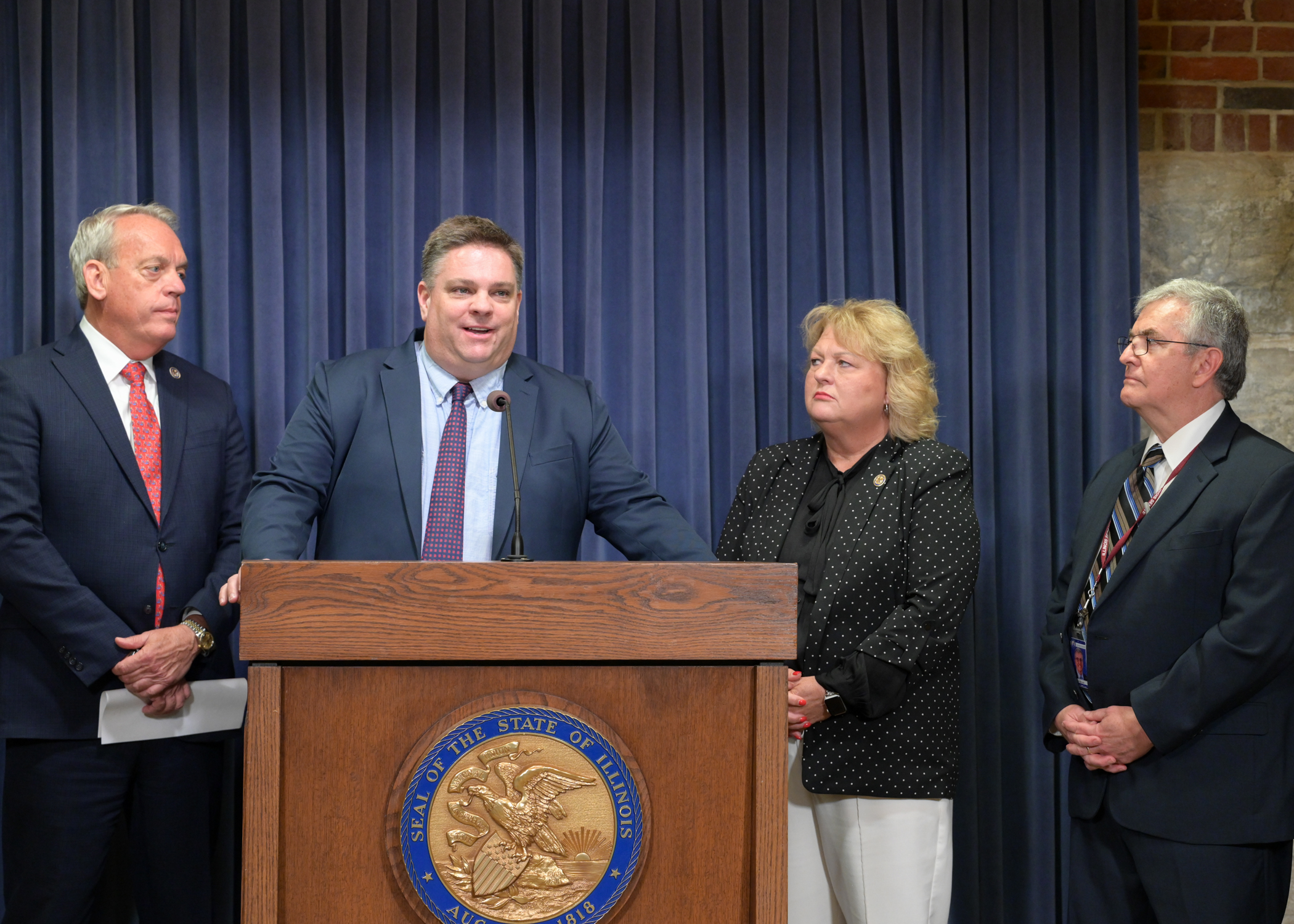
Illinois Senate Republicans http://www.ilsenategop.com Illinois Senate Republicans en-us GOP's Radogno, Cross call for repeal of Illinois' income tax hike
The top Republicans in the Illinois House and Senate are offering a one-year anniversary raspberry salute to the passage of a $7-billion state income tax hike, saying it hasn't worked and ought to be immediately repealed.

But at a Chicago news conference today, neither Senate GOP Leader Christine Radogno nor House GOP Leader Tom Cross offered any indication that majority Democrats will go along on taxes or state pension reform.

Democrats immediately shot back that lowering taxes to 2010 levels would worsen the state's precarious finances.

The tax hike, which raised levies by two-thirds, was enacted one year ago today on a wholly partisan vote.

The Republican leaders said the levy has cost the average family $1,000. To dramatize their point, they spoke at a podium flanked by $1,000 worth of pasta sauce, diapers, bread, cereal, barbecue sauce and other items (which actually cost $1,004.50 to purchase).

"This is real money — money that hurts working families," Ms. Radogno said. The tax hike needs "to go away."

Mr. Cross said the state could have avoided the hike and paid some bills if, instead of raising taxes, Democrats had agreed to reforms in Medicaid, pensions and other spending that Republicans want. All the tax hikes have done is "reduce the pressure to make changes," he said, and hurt Illinois' ability to compete for jobs.

Those themes were echoed by John Tillman, head of the Illinois Policy Institute, a libertarian research group. He released a poll saying 68% of state residents opposed the tax increase.

But Mr. Cross admitted he won't call his bill forcing state workers to pay more toward their pensions or accept lesser benefits until Democrats assure him they'll add enough votes on their side of the aisle to pass it.

"If the bill fails, what will we have accomplished?" he said, rejecting the notion that requiring every House member to take a public stand would accomplish anything.

Meanwhile, the institute's poll also found that only 53% of those surveyed believe the tax hike should be repealed immediately. Asked about that, Mr. Tillman noted that an additional 31% want it to expire as scheduled, beginning in 2015.

Both Ms. Radogno and Mr. Cross said they back immediate repeal.


]]>
http://madison.weareillinois.org/newsdetail.aspx?newsid=12147 http://madison.weareillinois.org/newsdetail.aspx?newsid=12147 Thu, 12 Jan 2012 12:27:00 GMT
Moody's gives Illinois lowest credit rating of any state
Illinois, unable to solve its long-running financial problems, was given the lowest credit rating of any state in the country by Moody’s Investors Service on Friday, a move that will increase costs to taxpayers. 

A second agency, Standard & Poor’s, left its Illinois rating unchanged but warned of a negative outlook that could lead to a downgrade in the future. A day earlier, Fitch Ratings also left the rating unchanged and declared a stable outlook. 

Lower credit ratings generally mean the state pays more interest when it borrows money by selling bonds. 

Both Moody’s and S&P said they are troubled by Illinois’ failure to balance its budget and strengthen government pension systems, although a tax increase and other measures have helped. 

Moody’s cited “weak management practices” and a recent legislative session that “took no steps to implement lasting solutions.”
  
Moody’s now rates Illinois “A2,” below any other state. Only one state, California, qualifies for the next-highest rating. All the rest are ranked higher. 

Standard & Poor’s flip-flops the states in its ratings. California is worst, with Illinois a notch above. 

Gov. Pat Quinn’s office said it was “encouraged” that two of the three agencies decided not to lower the Illinois rating.

Spokeswoman Kelly Kraft attributed it to cost-cutting and efforts to overhaul Medicaid, pensions and workers’ compensation. 

“More needs to be done,” Kraft added. 

She said lawmakers should support additional efforts to control pension costs and  pay overdue bills. 

The top Republicans in the Illinois Legislature called the downgrade “very bad news.” Senate Minority Leader Christine Radogno and House Minority Leader Tom Cross said lawmakers must approve major pension and Medicaid changes in the next session.
 
“Obviously the practice of nibbling around the edges ... has not convinced these bond rating agencies that we are on the road to recovery,” they said in a statement. 


]]>
http://madison.weareillinois.org/newsdetail.aspx?newsid=12145 http://madison.weareillinois.org/newsdetail.aspx?newsid=12145 Wed, 11 Jan 2012 14:04:21 GMT
Dillard, GOP unveil jobs plan 4/14/11

SPRINGFIELD — A group of Illinois Senate Republicans led by Sen. Kirk Dillard of Hinsdale proposed a plan Thursday to try to jump-start Illinois’ economy.

The 30-point plan hinges on reforming the workers’ compensation system, which business groups say costs too much money in Illinois. But the state Senate voted down a workers’ compensation reform measure on Thursday.

The Republican plan also calls for more tax credits for companies and eliminating some regulations. The plan, for example, calls for eliminating most air permits required by the Illinois Environmental Protection Agency. Other ideas come from other states.

“There is nothing against plagiarizing good ideas from other states,” Dillard said.

Democrats control all levels of state government, though, so it could be difficult for the GOP to get their plans approved.


]]>
http://madison.weareillinois.org/newsdetail.aspx?newsid=11567 http://madison.weareillinois.org/newsdetail.aspx?newsid=11567 Fri, 15 Apr 2011 07:13:03 GMT
H&R: Plan is good start in spending cuts
Republicans in the Illinois General Assembly have finally unveiled a plan that addresses the state's key financial issue: spending.

The Republican plan calls for spending cuts of $6.7 billion, an amount that members say would allow the state to roll back the 66 percent income tax increase approved during the lame-duck session and clear up the massive backlog of unpaid bills within two years.

The plan is a bold one, but its political future is doubtful at best. Hopefully, it will serve as a starting point, however, for addressing the expense side of the state's budget crisis.

The biggest part of the plan is also the most speculative. Republicans call for saving $1.35 billion with pension reform. That plan includes requiring current retirees to pay more for their health care and other pension reductions. Democrats claim that such changes go against the state's constitution, and Republicans admit it may be necessary to amend the constitution to reap those savings.

The GOP plan also would freeze state worker pay, including union workers. It would also drastically cut state assistance to education and local governments and combine the only two statewide offices held by Republicans: comptroller and treasurer.

Gov. Pat Quinn was less than enthusiastic about the plan, calling it "foolhardy." But Senate President John Cullerton, D-Chicago, said it was a good foundation on which to begin budget talks.

Moving any significant budget reductions through the General Assembly is difficult. Special interest groups are effective at lobbying for their funds and programs to be left alone, and the Democrats that control the legislature have not shown a desire to reduce the state's spending habits.

Cuts to local school districts and governments can be uncomfortable, but the process would be worth the time if it moves some governments to consider a change in the way they operate. One way of saving tax dollars is for local governments to consider more collaboration and consolidation. That issue will never be seriously discussed, however, unless the money spigot is reduced to a trickle.

Most of the funding cuts proposed by the Republicans, however, are aimed at state government. That's as it should be, since state government has responded to the economic times by spending more, not less, money. While families, businesses and local governments have cut back, our state officials have continued to spend money. The time for some serious cutting is long overdue.

Taxpayers, who are being asked to spend more of their dollars on government, also need relief. As has been stated in these pages before, the cost of government has outpaced the ability of taxpayers to fund government.

The GOP plan will undoubtedly be changed as it proceeds through the General Assembly. But it is a good starting point for what taxpayers have to hope are meaningful discussions about reducing state spending.


]]>
http://madison.weareillinois.org/newsdetail.aspx?newsid=11438 http://madison.weareillinois.org/newsdetail.aspx?newsid=11438 Mon, 28 Mar 2011 07:58:05 GMT
Lake County News Sun: Sounding the alarm
State Republicans seem to be the only ones in Springfield who understand what happened last November, not only here but across the nation. Last week, the GOP unveiled a hard-times budget plan, calling for $5 billion in cuts from a $35 billion state budget proposed by Gov. Pat Quinn for next year.

The governor dismissed them, calling them “apostles of Draconian cuts,” adding, “I’m not listening to them.” This after Quinn challenged Republicans last month to craft their own budget plan if they rejected his.

Republicans are absolutely right to lay out major budget cuts. Despite major personal and corporate income tax increases in January, significant and painful budget cuts still are needed in Illinois.

The state owes its schools and social service agencies upward of $9 billion and is facing crippling pension costs. Those tax increases will help lighten that load, but Illinois also must scale back the cost of government to achieve true solvency.

Lake County municipalities and school districts are slashing their government payrolls — Waukegan is proposing to let go some 70 city workers, including police and fire, to cover its red-ink budget — and it’s time for the state to trim its work force. Private industry in Illinois has already done so and held pay increases to bare minimums, in some cases, asking for and getting givebacks.

The GOP plan calls for reducing pensions for current employees, and renegotiating state employee contracts, never an easy or quick process. State leaders should move forward on both fronts. As for cuts in the human services and educational areas, when your state is $15 billion in debt, something has to give in the short term until the Illinois and national economy perk up.

Republicans deserve plenty of credit for ringing the alarm bell in a responsible way and reviving a long-forgotten custom in Springfield. It’s called democracy, that intelligent, back-and-forth pursuit of the common good that long ago fell out of fashion in Springfield.

Meanwhile, the governor the other day touted high-speed rail from Chicago to St. Louis as a job-creating bonanza for Illinois. Don’t get us wrong, we think high-speed rail has merit. Only we can’t afford it right now because Illinois finances currently are on a runaway train.


]]>
http://madison.weareillinois.org/newsdetail.aspx?newsid=11425 http://madison.weareillinois.org/newsdetail.aspx?newsid=11425 Thu, 24 Mar 2011 11:00:04 GMT
Southtown: Quinn wrong to slap down GOP ideas
In the turn-of-the-screw climate of Springfield, it can be difficult to find bigger-picture meaning to what is happening. Each day offers a seemingly cataclysmic announcement, proposal or standoff over how to address Illinois’ budget mess.

Gov. Pat Quinn revealed his budget blueprint in February. And now, the competing interests of Democrats, Republicans and dozens of special interest groups are angling for their own influence over the end product.

Here is our capsule so far of developments and a few suggestions on where we should be headed:

Last week, Senate Republicans led by Sen. Christine Radogno (R-Lemont) unveiled a list of budget cuts totaling more than $5 billion. The detailed analysis was important because it included specific ways to reduce spending with meaningful numbers. Even after a 67 percent income tax hike, Illinois is in serious debt.

Radogno’s caucus represents 24 votes in the 59-body Senate chamber. Fifteen of her 24 are willing to vote on the cuts she offered.

Why are those numbers important? Because rarely does a legislative leader in Springfield put forth specific ideas to cut spending, fearing the backlash, and rarely do they put forth a number of committed votes on their proposals. That’s much too forward-thinking.

Radogno’s plan offered more budget specifics than the GOP’s own gubernatorial nominee last year.

Typically in Springfield, the Republicans or Democrats might suggest general cuts and hint they would round up the votes. But again — detail in the Capitol is rare.

Of the ideas presented, we support many of them: tightening eligibility for Medicaid, freezing spending on education programs, reducing compensation to prisoners and limiting the number of state-owned mobile devices and take-home cars. We also would like to see retired state employees pay more toward their health insurance and a severe reduction in money appropriated to the Illinois Arts Council.

Furthermore, we support Senate President John Cullerton’s proposal to peel back the video gambling law. Here is a chance for lawmakers to fix something they should not have passed in the first place. The $30 billion capital bill was simply too big, and dozens of communities statewide have pre-emptively banned video poker before the law has been applied. We don’t want it.

Lawmakers should reverse their 2009 action legalizing it and consider Cullerton’s idea for a cigarette tax hike.

While state lawmakers still have a lot of work to do before they adjourn in May, we are cautiously optimistic, based on the serious budget ideas being debated, they will not leave Springfield this time without having made some tough choices. We can certainly encourage them.

And rather than stomp on Senate Republicans’ ideas, Quinn ought to thank them for finally offering some serious suggestions—and he ought to take some of them into consideration.


]]>
http://madison.weareillinois.org/newsdetail.aspx?newsid=11397 http://madison.weareillinois.org/newsdetail.aspx?newsid=11397 Mon, 21 Mar 2011 07:19:03 GMT
Senate GOP united against Quinn borrowing plan
SPRINGFIELD, Ill. (AP) - Republicans in the Illinois Senate are warning the governor that they'll block any attempt to borrow money for paying overdue bills.

The Republican caucus declared Tuesday that they are unanimous in opposing the idea.

Democratic Gov. Pat Quinn says the state should borrow $8.7 billion to pay community groups, businesses and others who haven't been paid for doing work for the state.

But Republican leader Christine Radogno (rah-DOHN'-yoh) says Illinois should instead pay the backlog gradually by cutting spending. She said everything should be on the table for cuts, including education.

Radogno says many government programs don't do much to improve life for state residents. She offered child-care services as an example of what could be reduced.


]]>
http://madison.weareillinois.org/newsdetail.aspx?newsid=11257 http://madison.weareillinois.org/newsdetail.aspx?newsid=11257 Tue, 15 Feb 2011 12:44:30 GMT
Senate’s top Republican stands against borrowing proposal
Gov. Pat Quinn can expect to find a “stop sign” in the Senate for his proposal to borrow $8.75 billion to help pay down state bills, according to Sen. Minority Leader Christine Radogno, R-Lemont.

Quinn is expected to detail the proposal along with the rest of his budget plans during his budget address Wednesday in Springfield.

Speaking during a Chicago Southland Chamber of Commerce luncheon in Tinley Park on Monday, Radogno said she opposes Quinn’s borrowing proposal and Senate Republicans have the numbers to stop it.

After losing a few seats to Republicans during the November election, Democrats no longer have a two-thirds majority needed to approve the borrowing plan on their own.

“Borrowing cannot occur without bipartisan support, and I think bipartisan support on additional borrowing has been exhausted,” she said.

Instead of borrowing more money to deal with the state’s deficit, Radogno said Quinn should be looking for ways to reel in state spending.

Places where Radogno suggested finding addition savings include tightening up Medicaid eligibility and cleaning up fraud in the system, reforming state pensions for both future and current state workers, and possibly making across-the-board budget cuts for state agencies.

“It’s not going to be painless,” she said. “And anybody who tells you that is just plain wrong.”

Elaine P. Maimon, president of Governors State University, asked Radogno how she believes the state can catch up on its overdue payments like appropriations to public universities without borrowing.

“We wait and wait and they don’t come,” Maimon said of state payments. “So I just wonder what alternative plan there might be, for universities in particular, to get their appropriated funds without borrowing?”

Radogno said those payments should begin to be made with new revenues from the 67 percent income tax increase approved last month.

“Even if we can’t pay you every penny because it’s not all coming in at once, we can certainly start,” she said.

In addition to dealing with the state’s deficit, which threatened to hit $15 billion before lawmakers passed the tax increase, Radogno said the big issue on her legislative radar, as well as everyone else’s in the General Assembly, is job creation.

“Everyone I believe at this point agrees that Illinois has lagged in job creation, not only in the nation but amongst our peer states and amongst our neighboring states,” she said.

She said she expects legislation to surface this session that will attempt to streamline the regulatory process for private businesses and try to bring the costs of worker compensation and unemployment insurance closer in line with surrounding states.

She also said there’s a new bill being floated that would increase the state’s minimum wage again, but that’s a step she doesn’t personally support.

“I’m not for that, I think that that’s going to put us at an additional disadvantage, so I hope that when we consider that bill, it’s looked at in the context of what it will do to business development.”


]]>
http://madison.weareillinois.org/newsdetail.aspx?newsid=11256 http://madison.weareillinois.org/newsdetail.aspx?newsid=11256 Tue, 15 Feb 2011 11:35:18 GMT
Johnson takes oath to officially become state senator
SPRINGFIELD – Before a small crowd Monday, Christine Johnson placed her hand on her grandmother’s Bible as she was sworn in as Illinois’ newest state senator.

“I’m very excited to be part of the Illinois Senate. I consider it a privilege and an honor,” Johnson said. “I’m proud to represent the people of the 35th (Senate) District.”

The former DeKalb County treasurer is replacing Brad Burzynski, R-Rochelle, who recently retired.

Johnson is one of several new faces in the Senate Republican caucus this year.

Senate Republican Leader Christine Radogno, R-Lemont, praised Johnson at Monday’s ceremony.

“I got to know Christine in ’06 when I ran statewide, and she was my DeKalb County coordinator,” Radogno said. “So right away, I found out that she was someone who works hard, does what she is going to do, has the right outlook on life and government. She is someone I admired back then, and I am delighted to have her in our caucus now.”

Burzynski announced his retirement in late January after serving in Springfield since 1990, first in the House. He was elected to the Senate in 1992. Burzynski said he was retiring to spend more time with his family.

He was in Springfield on Monday to observe the ceremony and spoke to Johnson. “I wanted to hand over the keys of the Capitol to you, and that way you will be able to get in and out of your office,” Burzynski said,  “although she was already in the office. I got down here [Monday], and her pictures were up and mine were down.”

Johnson said she is excited to tackle her new role. “I’m very optimistic about the future. No doubt, we will have some challenges ahead of us, but with determination, hard work and wise decisions, we can rise above our current situation and make the state of Illinois a great one again,” she said.


]]>
http://madison.weareillinois.org/newsdetail.aspx?newsid=11255 http://madison.weareillinois.org/newsdetail.aspx?newsid=11255 Tue, 15 Feb 2011 11:32:50 GMT
Republicans move to repeal tax increase The Daily Herald

SPRINGFIELD — Republicans wasted no time starting a fight to repeal the income tax increase that Gov. Pat Quinn signed into law Thursday, even though top Democrats almost certainly would block such an effort.

Sen. Matt Murphy, a Palatine Republican, said he filed legislation Thursday to repeal the increase, which raises the personal income tax rate to 5 percent and corporate income tax to 7 percent for the next four years.

Repeal legislation also was filed in the House by Rep. Michael Connelly, a Lisle Republican.

The efforts could be futile, though. Quinn would be unlikely to sign a law that would repeal one he just approved.

“The administration has no interest in considering proposals motivated by politics, rather than a desire to find real solutions to Illinois’ budget crisis,” said Quinn’s spokeswoman Annie Thompson.

Still, Murphy wants to press on.

“I think we should push, as the governor said the other day here, to make the will of the people the law of the land,” Murphy said.

Sen. Chris Lauzen, an Aurora Republican, said the tax increase, which allows for a 2 percent increase in state spending, could end up hurting the state finances more than it helps.

“Only after cuts and we’ve restored trust in government ... then let’s look at tax reform and modernization,” he said. “But we have to first establish that we’re not going to throw away the new money like the old money.”

Even though the majority of the General Assembly voted in favor of the tax increase less than three days ago, Murphy said he thinks he can find enough votes among newly sworn-in lawmakers to repeal the measure.

A new set of lawmakers were sworn in to office Wednesday, just hours after their predecessors voted to increase taxes.


]]>
http://madison.weareillinois.org/newsdetail.aspx?newsid=11158 http://madison.weareillinois.org/newsdetail.aspx?newsid=11158 Tue, 01 Feb 2011 07:33:54 GMT
GOP picks Burzynski replacement
By Benjamin Yount
FOX 55/27 Illinois Statehouse News

SPRINGFIELD – The new class of lawmakers at the Illinois Capitol continues to grow.

Republicans have selected a replacement senator to fill the rest of the term of state Sen. Brad Burzynski, R-Sycamore. Longtime DeKalb County Treasurer Christine Johnson has gotten the nod. Johnson was supposed to start in Springfield this week, but legislative leaders canceled session because of the expected snowstorm.

Burzynski, who has served in Springfield since 1990, said it's just time to go.

"My wife and I have been talking about this for the past several months," he said. "Particularly since we knew we were going to have two more grandchildren, that brings our total to five and none of them live close…So we said, we need to take care of some family things and spend more time with our family."

Burzynski served nearly two terms in the Illinois House, then moved to the state senate in 1993. Now Johnson will have to face voters, as well as a potential challenger in just two years. But Johnson said that after 17 years as an elected county treasurer, she is not sweating the 2012 ballot.

"My mom grew up in Loves Park and my grandparents lived in Rockford until they passed away, so it's not that I am unfamiliar with the (Senate district)," she said. "And I'm very anxious to get out and meet the citizens and officials in all of the district."

The 35th Senate District touches parts of five counties, but the biggest segment of voters live in DeKalb and Winnebago Counties. DeKalb County Republican Chairwoman Mary Simons said that area has been one of the most Republican in the state for a while, and she hopes Johnson can keep it that way.

"[Johnson] is very well-known in DeKalb County and she has very, very strong ties in Winnebago County," she said. " And as a campaigner, she is everywhere."

Burzynski said that presence and campaign strength is one of the reasons why he put Johnson's name forward as his personal choice for a replacement. Johnson was selected over state Rep. Bob Pritchard, R-Sycamore, and former Sycamore mayor Jim Edwards.

"I think [Johnson] is really philosophically very similar to myself. And I thought she would be able to come into Springfield, and come into the Senate Republican caucus and help make that caucus strong," said Burzynski.

Johnson is just the latest addition to the Senate GOP. Republicans picked up a handful of seats last November. Johnson is also the latest woman to join what had been a primarily male team among Senate Republicans, and Simons said that was a factor in selecting Johnson.

"Christine just impressed everyone…I think it's her vitality, she was the youngest candidate," she said. "And I guess I can't discount the fact that she is a woman."

Burzynski is quick to point out that Republicans in the Illinois Senate are the only caucus in Springfield with a female leader. State Sen Christine Radogno, R-Lemont, leads the GOP in the state's upper chamber

Johnson will take over after Valentine's Day. She said she's now trying to get up to speed on what will unfold this spring.

"The past General Assembly had some interesting activity," she said. "But I think the focus that we need to take right now, before anything else, we need to get our fiscal house in order."

Lawmakers are scheduled for a full spring of session, with just two weeks off between February and June.


]]>
http://madison.weareillinois.org/newsdetail.aspx?newsid=11157 http://madison.weareillinois.org/newsdetail.aspx?newsid=11157 Tue, 01 Feb 2011 07:17:45 GMT
Same old Springfield January 10, 2011

The inauguration of a governor ought to signal fresh approaches, new energy and grounded anticipation of better days ahead. If you focused just on Monday's oath-taking in Springfield, you might have believed that's all in the cards. Gov. Pat Quinn declared that "we have replaced a government of deals with a government of ideals."

But think for a moment. What have we seen in the days leading up to this inauguration? A classic exercise in clandestine government deal-making.

The governor and Democratic leaders have been pushing to line up votes for a breathtaking tax increase on recession-thwacked Illinoisans and their employers. Yet there has been no public proposal or press conference to help citizens understand the plan. There has been no bill for taxpayers — Yoo-hoo, anybody in the Statehouse thinking about taxpayers? — to read, or for journalists to assess. And there has been no governor answering questions about why he first isn't more aggressively slashing state expenses.

News stories about Quinn darting down hallways to avoid inquisitors reminded us of Rod Blagojevich, famously dodging his budget director by hiding in a bathroom.

In sum, Illinois has a newly inaugurated governor and, more important, the same old way of doing business, concluding in a manufactured rush. Quinn, House Speaker Michael Madigan and Senate President John Cullerton have had two years to reduce spending and return Illinois to solvency. They're trying to make us all think some dramatic deadline is nigh, for only one reason: On Wednesday this lame-duck legislature quacks its last. Don't be astonished if, in coming months, you read exposes about exiting legislators who cast votes to raise state taxes and debt — and who then miraculously landed secure public jobs or judgeships.


]]>
http://madison.weareillinois.org/newsdetail.aspx?newsid=11141 http://madison.weareillinois.org/newsdetail.aspx?newsid=11141 Tue, 25 Jan 2011 14:45:51 GMT
The worst is yet to come in Illinois
Chicago Tribune
By Dennis Byrne
January 25, 2011

All you state retirees: Do you really believe that your pension was in any way secured by those blow-off-the-roof income tax increases? All you hospitals and social services that are owed billions: Think that check will arrive soon?

Should we think that tax increases will halt the torrent of state borrowing that put us so deep in debt in the first place? Will it drag the state's credit rating from off the floor?

Truth is, you've been chumped. None of that is happening.

Let's do the simple math: The new revenues will produce $6.5 billion. That amount has to cover a $15 billion budget deficit. Failing a miracle of loaves and fishes, it won't work.


]]>
http://madison.weareillinois.org/newsdetail.aspx?newsid=11140 http://madison.weareillinois.org/newsdetail.aspx?newsid=11140 Tue, 25 Jan 2011 14:39:45 GMT
Mom 1, Machine 0
State Sen. A.J. Wilhelmi has a fight on his hands, and his Democratic bosses have only made it worse.

Party leaders brought out the big guns to try to blow Republican challenger Cedra Crenshaw off the November ballot for the 43rd District seat. But a Will County judge ruled Wednesday that Crenshaw's ballot petitions are valid, rejecting the argument contrived by the Democrats who wanted Wilhelmi to coast to victory unopposed.

Grasping at the straw extended to them by the state Democratic Party's top elections attorney, Michael Kasper, the pliant Democratic majority on the Will County elections commission had swiftly thrown out Crenshaw's petitions based on a hypothetical — or shall we say imaginary — quandary.

Crenshaw's petitions stated that the signatures were collected within 90 days prior to the filing deadline. But the wording — supplied by state law — didn't fit her candidacy precisely, since she was recruited to fill a ballot vacancy after nobody ran in the primary. She was nominated March 30, leaving only a 19-day window to collect signatures before the filing deadline. If you squint really hard, the elections commission said, the wording "leaves open the possibility" that Crenshaw collected signatures before she was nominated.

As Will County Circuit Judge Bobbi Petrungaro pointed out in her ruling, that could have been addressed by granting Crenshaw a hearing, but the electoral commission refused. Petrungaro rightly declined to base her ruling on an unchallenged "possibility." Democrats produced zero evidence that Crenshaw circulated her petitions illegally.

So she's officially in the race.

It's going to be a good one. Once a long shot in a heavily Democratic district, Crenshaw has become a tea party sensation thanks to the heavy-handed tactics of her opponents. Her story line — suburban mom standing up to the Chicago Machine — has scored her plenty of national media attention.

That's not what the Dems had in mind when they decided to bully her off the ballot. Wilhelmi has said he won't appeal the judge's decision. That's good. Like it or not, it's time to face the voters.


]]>
http://madison.weareillinois.org/newsdetail.aspx?newsid=10129 http://madison.weareillinois.org/newsdetail.aspx?newsid=10129 Thu, 22 Jul 2010 09:33:04 GMT
Bolingbrook 'mom' deserves to remain on the ballot July 15, 2010
By Kristen McQueary

In the end, state Senate candidate Cedra Crenshaw, of Bolingbrook, likely will remain on the ballot. But only because she pulled every lever available to her, including the race card. On this one, I'm on her side.

Crenshaw is a black homemaker and former accountant who is fighting for the chance to contest incumbent state Sen. A.J. Wilhelmi (D-Joliet) on Nov. 2. Wilhelmi's 43rd District includes most of Homer Township and all of Lockport.

But as any newcomer knows, running for office often is the easy part. Getting on the ballot requires armor.

If you read this column on a semi-regular basis, you won't be surprised at my indignation. More and more, incumbents expect to be carried through campaign season on chariots. Perhaps we can kiss their rings as they careen down the next parade route.

Not only do their staffs do the grunt work of collecting signatures to get them on the ballot, incumbents also don't want to bother with competition.

In some cases, a heavy boot is worthwhile. For example, a third candidate who filed in the 43rd District filed no valid signatures. He deserves to be removed.

But when newcomers substantially meet the requirements to be placed on the ballot, electoral boards ought to respect democracy and allow them to run. Numbering pages incorrectly, misspellings and - in Crenshaw's case - interpreting differently a window of time to circulate petitions are not reasons to remove a candidate. She was removed by a Democrat-led board, even though there was no evidence she circulated her petitions outside the allowable time frame.

She appealed. Will County Circuit Court Judge Barbara Petrungaro - a Republican running unopposed for the 5th Subcircuit - is scheduled to hear her case Tuesday.

Wilhelmi said he will not appeal if Crenshaw is put back on the ballot.

"I look forward to moving on and talking about the issues of the district," he said Wednesday.

Crenshaw's case has attracted national attention.

"Why is the Chicago machine so afraid of a black conservative mom from Bolingbrook, Illinois?" she said at a recent Tea Party rally. "There are a few reasons, but the first is because they can't use their typical playbook. They can't call me a racist, evil, rich white man. They can't play that game."

Wilhelmi's campaign already is trying to discredit Crenshaw. She's not "just a mom," they said.

Her attorney is Burt Odelson, Cook County Board President Todd Stroger's parliamentarian. Odelson also spent a few days as a consultant to President Bush's 2000 campaign.

"The Crenshaw campaign has repeated over and over again that she is just one mom, but how many moms do you know (who) have George W. Bush's attorney?" Senate Democrats' political director Jay Rowell asked.

To that, I chuckled. It's quite a stretch.

I interviewed Odelson in 2000 when he was called to Palm Beach County in Florida to explain a precedent-setting 1990 Illinois Supreme Court decision he had argued. The case dealt with dimpled chads. Odelson was sent to Florida to explain the ruling to election judges. He was hardly Bush's chief legal counsel. Hundreds of election attorneys flew to Florida to watch the ballot recount.

Rowell also described Crenshaw's campaign manager, Mark Batinick, as a "professional Republican operative."

That's also misleading. Batinick is a real estate agent and first-term GOP precinct committeeman from Plainfield who is volunteering on Crenshaw's campaign.

"I have a full-time job," Batinick said. "I got involved because I'm in business here. The worker's compensation rate is double in Illinois. The gas tax is higher. License plate fees are higher. It's driving businessmen like me out of the state."

He continued, his voice rising: "The fact is, in (Crenshaw's) case the electoral board waited six weeks and two days to make a decision on a technicality. Sorry, that's egregious. That's sheer politics. It's the corruption I can't stand, and it absolutely pisses me off."

Crenshaw is getting help from Senate Republicans to pay for her legal battle. That is true.

But she circulated her own petitions door to door. She doesn't have a staff or a polling firm or a communications team. So to me, she's still "just a mom."

Senate Democrats have spent major resources to keep her off the ballot, not because she's black but because she's smart.

Wilhelmi had hoped to coast to re-election unopposed. Now, he just might have to work for it.


]]>
http://madison.weareillinois.org/newsdetail.aspx?newsid=10066 http://madison.weareillinois.org/newsdetail.aspx?newsid=10066 Thu, 15 Jul 2010 06:22:24 GMT
Tribune: Mom vs. Machine July 13, 2010

From the start, Illinois Senate hopeful Cedra Crenshaw wasn't just running against Democratic state Sen. A.J. Wilhelmi, of Joliet. A darling of the tea party movement, she sometimes sounds like she's running against Barack Obama and the Democratic Congress. These days, she's running hard against the Chicago Machine, which seems quite afraid of her.

Crenshaw, of Bolingbrook, is an accountant and auditor turned stay-at-home mom. She's also African-American. Three kids and a mortgage "catapulted me into the conservative I am today," she says. Her campaign stresses fiscal responsibility and government accountability; she supports Second Amendment rights and traditional marriage and opposes abortion.

With no candidate in the primary, Will County Republican leaders needed someone to challenge Wilhelmi in November, and Crenshaw said yes. Nominated on March 30, she had only 19 days to collect 1,000 signatures before the filing deadline.

She turned in 1,500.

And then the Democrats noticed.

The Will County Electoral Board threw her off the ballot last week after the Democrats sent in attorney Michael Kasper to keep her off the ballot. The two Democrats on the election board rejected her. The lone Republican voted to let her run. A Will County judge will consider her appeal Wednesday.

The Democrats on the election board dumped Crenshaw on a specious technicality. The ruling says her petitions weren't properly certified because they stated that they were circulated "not more than 90 days preceding the last day for filing." That wording was copied straight from the law. Crenshaw had only 19 days in which to collect signatures, not 90. The Democrats — Circuit Court Clerk Pamela McGuire and State's Attorney James Glasgow — said the wording "leaves open the possibility" that the petitions were circulated before Crenshaw became a candidate. Crenshaw offered to provide a sworn statement clarifying the dates but wasn't allowed to do so.

The Democrats played "gotcha!" with her. The nerve of her, taking on Sen. Wilhelmi.

We're talking about an Illinois citizen who is making a legitimate effort to challenge the political status quo. And who, in return, is being slammed down by the status quo. Exactly the kind of thing that has people furious about politics.

County Clerk Nancy Schultz Voots, the lone Republican on the election board, dissented from the decision, saying Crenshaw had used wording supplied by the law.

"If it is unclear what verbiage ought to be used in the certification, it is because the legislation itself is unclear," she wrote.

We hope the judge sees it that clearly. As the board's own ruling notes, "access to a place on the ballot is a substantial right and is not lightly to be denied."

Crenshaw was bounced from the ballot, which just goes to show you how panicked the Dems are about the prospect of being held accountable in November.

"The Chicago Machine is afraid of me because I am a conservative black woman, backed by the tea party, with a winning message that is winning over typical Democratic constituencies," Crenshaw says.

She deserves a chance to prove that. She needs to be on the ballot in November.

Wilhelmi is an incumbent in what would usually be considered a safe district, but voters are fed up. Democratic leaders apparently like their chances better in the courtroom than in the voting booth.


]]>
http://madison.weareillinois.org/newsdetail.aspx?newsid=10051 http://madison.weareillinois.org/newsdetail.aspx?newsid=10051 Tue, 13 Jul 2010 20:47:06 GMT
Joliet Herald-News: Decision injustice for Crenshaw
Cedra Crenshaw's experience with the Will County Electoral Board is the perfect example of why the public is so disgusted by politics in Illinois.

Electoral board members voted 2-1 along party lines to remove Crenshaw from the November ballot as the Republican nominee against state Sen. A.J. Wilhelmi, D-Joliet. Democrats Robert Lorz, assistant of State's Attorney James Glasgow, and Circuit Court Clerk Pamela McGuire voted to oust Crenshaw, while Republican County Clerk Nancy Schultz Voots saw nothing wrong with Crenshaw's petitions.

One would hope that this decision wasn't based purely on politics, but, unfortunately, the electoral board's majority decision frankly is a pathetic, arbitrary attempt to keep Crenshaw, a Bolingbrook homemaker and darling of the local tea party groups, off the ballot.

Lorz and McGuire contend that there was a "possibility" that Crenshaw circulated petitions for her state senate candidacy prior to March 30, which would be less than 90 days preceding the last day for filing of the petitions, a violation of Illinois election statutes.

And what evidence did McGuire and Lorz use for removing Crenshaw from the ballot? That Crenshaw was able to collect 1500 signatures in just 19 days before having her petitions certified.

"The certification leaves open the possibility that the petitions were circulated during a time period that was well outside that which is statutorily prescribed," the majority of the board stated.

Fascinating. In other words, it could have happened that Crenshaw circulated petitions prior to March 30. She attempted to have submitted to the electoral board a sworn affidavit from her that stated she did not commit such a statutory violation, but the majority ignored her request.

We stated on May 30 that there was no proof to remove Crenshaw from the ballot and our position is even stronger. Nowhere on the petitions is there a place that states as to the dates of when the petitions are circulated. So, the electoral board majority is using conjecture and theory rather than proof.

We also believe that Lorz, a former judge, would have the ability to decide such matters based on evidence, not "possibilities."

But one more troubling aspect comes from this vote. Every person who circulated petitions, as well as the candidate herself, must sign each petition page and state that all rules were followed, including the 90-day restriction, "to the best of my knowledge and belief."

The electoral board majority stripped all 1500 signatures from Crenshaw, which means that Lorz and McGuire did not believe the notarized statements from the circulators and Crenshaw.

In other words, Lorz and McGuire believe that Crenshaw and her petition circulators were lying. If that's the case, then the state's attorney's office should file perjury charges and seek indictments against Crenshaw and all of her circulators.

Lorz and McGuire can't have it both ways. If a "possibility" exists that the petitions are false statements, then a "possibility" exists of lying on these certified documents.

Still, based on this majority electoral board decision, what proof is there that Wilhelmi, his supporters or other candidates didn't circulate petitions before the prescribed time?

We would hope that a circuit court judge would see the lack of proof and put Crenshaw back on the ballot.

The electoral board's 2-1 decision is another lesson in how politics are played in Illinois.

People who want to run for office and dare challenge those in power have to jump through many hoops, and as the electoral board has shown, some of these hoops are invisible ones.


]]>
http://madison.weareillinois.org/newsdetail.aspx?newsid=10050 http://madison.weareillinois.org/newsdetail.aspx?newsid=10050 Tue, 13 Jul 2010 20:45:06 GMT
Wilhelmi challenger is off Nov. ballot By STEWART WARREN
The Bolingbrook Sun

JOLIET -- Cedra Crenshaw is off the ballot.

As it stands today, she won't be on the November ballot as the Republican candidate for the 43rd district senate seat now held by A.J. Wilhelmi, the Democrat from Joliet. The Will County Electoral Board voted 2-1 on Wednesday against her candidacy.

This year, the board is comprised of Will County Clerk Nancy Schultz Voots, Circuit Clerk Pam McGuire and Bob Lorz of the Will County State's Attorney's Office. Lorz is sitting in for State's Attorney James Glasgow.

Voots cast the lone vote to keep Crenshaw on the ballot.

Objection filed

Crenshaw, 37, a Bolingbrook resident, mother of three and a Republican who last worked as an accountant, entered the race March 30, when the February primary election was long over. Local Republicans had asked her to run against Wilhelmi in the November general election.

Joliet resident Robert L. Davis then filed a formal objection to her candidacy claiming that nearly 1,300 of the signatures on Crenshaw's petitions weren't valid and citing several reasons.

On May 24, the electoral board heard arguments from both sides on the issue. During that hearing, it was clear that the signatures weren't the issue. Instead the opposition argued that Crenshaw's nominating petitions didn't list the dates when the petitions were signed. At the end of the proceedings, the members of the board said that they would announce their decision in writing on an unspecified date. But as of late last week, the board hadn't said a thing.

Electoral board hearing

Tired of waiting for an answer, Burt Odelson, the respected election lawyer representing Crenshaw, asked the board July 1 for another hearing. Crenshaw's supporters -- including another well-known lawyer, Richard Kavanagh, the chairman of the Will County Republicans -- were ready to tell the board the actual dates when the signatures were gathered.

That hearing was held Wednesday morning in a Will County courtroom packed with Crenshaw's supporters. People were literally standing against the walls, listening.

"Just rule (on the issue)," Odelson said. "Rule against me ... All I'm asking for is a little justice to allow me to proceed." Once the board announced its decision, he would move on, perhaps to the next step, a filing in Will County court, Odelson said.

At a certain point, things became a little heated in the courtroom when Lorz, a retired Will County judge, laughed at Odelson. Then Lorz began lecturing Odelson. As that went on, some of the people sitting in the gallery began muttering and shifting in their seats.

Ruling announced

Near the end of the proceedings, the electoral board voted 2-1 to deny Odelson's request for an opportunity to present evidence to prove when the signatures were collected.

Odelson then asked for the electoral board to vote either for or against Crenshaw. He wanted to know if she was staying on the ballot or being knocked off, and he wanted the vote to be done in public.

"Please make a ruling," Odelson said.

The decision would be announced later in the day, Voots said.

"That's not the way it works," Odelson countered. "You have to take a vote (in public)."

But the board members wouldn't give in.

"As county clerk, my job is to get this moving," Voots said. "I want to make sure the candidates' names are printed on the ballot the way they should be." Absentee voting begins Sept. 23, she said.

"It's unfair that the board is stalling," Crenshaw said after the hearing. "This is not about me. This is about the voters of the 43rd senate district who are being disenfranchised. We deserve a decision."

She then spent quite a bit of time talking to her supporters who were at the hearing. One by one, Crenshaw greeted them, taking the time to shake their hands and chat.

Not long afterward, the members of the board announced their decision. Crenshaw was off.

But Kavanagh said that paperwork would be filed in the courthouse today or Friday asking a Will County judge to overturn the board's decision.


]]>
http://madison.weareillinois.org/newsdetail.aspx?newsid=9995 http://madison.weareillinois.org/newsdetail.aspx?newsid=9995 Thu, 08 Jul 2010 07:24:40 GMT
Incentive helps lands FedEx in Grayslake The Daily Herald
6/26/2010

FedEx Ground has chosen Grayslake for its fourth Chicago-area distribution facility in a deal that required the cooperation of several public agencies and a tax incentive worth nearly $1.2 million.

The project, the first to be solely located in what is known as the Central Range, eventually would result in more than 700 jobs and represents a victory over Wisconsin, which has siphoned jobs from the area in the past few years.

"We were able to provide incentives that gave us the competitive edge," Lake County Board Chairman Suzi Schmidt said during a news conference Friday to introduce the project.

Construction of the $38 million sorting and delivery center on Route 83, north of Peterson Road, could begin later this summer and open in late 2011.

It would join facilities in McCook, Carol Stream and Wheeling to incorporate automated sorting equipment, as the company continues a growth and expansion surge.

"This is part of our strategic project to accelerate the speed of our network," said Thomas Beeman, managing director of the company's Midwest district.

The company has added nine hub facilities since 2002, including one last year in Bedford Park.

The prospect of jobs and the anticipated power of FedEx to trigger a chain reaction of other businesses coming to the area convinced several entities to forego half of their expected property taxes for five years. FedEx Ground is the small-package unit of FedEx Corp.

Grayslake High School District 127, Fremont Elementary District 79, Grayslake Elementary District 46, Lake County, the village of Grayslake and the Grayslake Fire Protection District will participate in the pact.

"The unemployment numbers for Mundelein alone were 14 percent a couple of months ago," said Lake County Board member Diana O'Kelly. "We have so many people who are unemployed and we need these jobs."

Forty construction jobs would be created to build the 214,000-square-foot facility, which initially would employ 200 full- and part-time workers.

At full capacity, an estimated 496 (448 part-time, 48 full-time) would work in the plant and 192 truck drivers would be needed.
Because the 40-acre site has been vacant, property taxes have been virtually nil. The argument is half of something for five years is better than nothing.

Once it is up and running, the facility is expected to generate more than $555,000 in property taxes, which are divided by the entities to varying degrees.

Steven Anderson, president and CEO of Lake County Partners, the county's development arm that pursued and sealed the deal, said FedEx originally considered 16 sites. The list was narrowed with Genoa, Wis., as a chief competitor.

"We were competing against a Wisconsin package. That's the reason for those incentives," he said.

The company also is pursuing an incentive from the state, he said.

Anderson said he personally dislikes incentives, and several companies requesting them have been denied because they weren't justifiable.

"You have to create a return for the taxpayers," he said.

Besides the incentive, FedEx liked the location, work force and other factors, according to Anderson. The decision is a boost for Lake County, he added.

"If it wouldn't have been FedEx now, it wouldn't have been anyone for two or three years," Anderson said.


]]>
http://madison.weareillinois.org/newsdetail.aspx?newsid=9931 http://madison.weareillinois.org/newsdetail.aspx?newsid=9931 Mon, 28 Jun 2010 19:04:59 GMT
Time for Crotty to stand on her own feet The Southtown Star
June 24, 2010

For more than a decade, state Sen. Maggie Crotty (D-Oak Forest) has represented the Southland in Springfield.

She served four years in the House, followed by eight years in the Senate. In addition to her role as senator, she serves as Bremen Township supervisor and Bremen Township Democratic committeeman, a political post that creates for her a seamless power structure.

She oversees at least four political action committees, although only one, Friends of Maggie Crotty, regularly presses for donations.

Not many voters would characterize Crotty as egotistical or politically power hungry. She's the quintessential girl next door.

But it's time, actually well beyond, for her to stand on her two perky feet.

For the second time in a year, Crotty is benefitting handsomely from House Speaker Michael Madigan's Democratic empire. His top elections attorney, Michael Kasper, worked fastidiously this spring to clear the ballot for her Senate re-election campaign.

When Republican officials slated Tinley Park school board member Adam Wojcik to run against her, Kasper dutifully challenged the signatures that Wojcik collected, including petition sheets filed by his parents.

After bogging down Wojcik's campaign in paperwork and attorney fees, it appears Wojcik will remain on the Nov. 2 ballot. He is hosting a fundraiser Friday night - cautiously.

Madigan's attorneys also kicked Sarah Hamm from the ballot last spring in Crotty's supervisor race.
In both races, Crotty didn't need the party's intervention. And if she does need the hand-holding, she shouldn't be representing us in Bremen Township or in Springfield. Not after 12 years and three elected offices.

Here's a little tutorial on the process:

Because Wojcik didn't run in the Feb. 2 primary election, Republican officials had the option of slating a candidate. Led by Bremen Township GOP committeeman Patrick Rea, the committee in March chose Wojcik - a Brother Rice High School graduate, West Point academy graduate, field artillery officer for the Army with two tours in Iraq, and now a Kirby School District 140 board member. He and his wife, Jillian, are expecting their first baby this fall.

The slating process allows candidates to avoid a public vetting. Therefore, they merit scrutiny. No one is saying Wojcik deserves a cakewalk onto the ballot.

But like so many campaigns during the past 10 years, election lawyers take "scrutiny" to an undemocratic, highly technical level. They try to wear candidates down, pester them with paperwork and dry their campaign funds over minutiae.

In Wojcik's case, Crotty's attorneys tried to argue that because his parents pulled Democratic ballots in the February primary, they shouldn't be allowed to circulate petitions for a Republican candidate. There is no state law that creates that mandate. Nothing.

Crotty's attorneys also argued that certain paperwork was filed late.

The Illinois State Board of Elections deadlocked on both issues, meaning Wojcik will remain on the ballot unless Crotty appeals through the courts, according to Wojcik's attorney, Burt Odelson.
Crotty didn't return three phone calls Wednesday to her district offices in Oak Forest and Springfield. I also left a message, late in the afternoon, at Bremen Township.

The bottom line is this: Incumbents already receive gobs of help when they seek re-election. They often receive staff and campaign donations without having to ask for it. So they don't need Madigan's slick lawyers to give them a free ride to an unopposed re-election.

If a challenger's petitions are in good shape, as Wojcik's were, party leaders ought to back off.
And if they don't back off, incumbents like Crotty should pick up the phone and tell them to. She should be proud to traverse the 19th Senate District, talk about her record and ask voters to send her back to Springfield.

Instead, the girl next door who ran for the Statehouse back in 1996 is starting to look more like a haughty insider, dependent on party heavyweights.

"This whole process is a move to take away choice from voters," Wojcik said. "In this climate, that's the last thing that should be taken away."


]]>
http://madison.weareillinois.org/newsdetail.aspx?newsid=9896 http://madison.weareillinois.org/newsdetail.aspx?newsid=9896 Thu, 24 Jun 2010 15:07:24 GMT
State Sen. Christine Radogno: Borrowing plan wrong for Illinois The State Journal-Register - Opinions
Jun 09, 2010

At the end of May, most Republican legislators decided they could not support Gov. Pat Quinn’s plan to borrow billions of dollars.

The governor and Democratic leaders characterized this as a political decision. As the Illinois Senate Republican leader, I’m proud of our record of forging bipartisan agreements on significant issues, including pension reforms, the state infrastructure investment program and the McCormick Place reform bill. I believe the public is seldom served by officials who lock themselves into rigid positions that do not allow for compromise.

When faced with accusations of partisanship, I feel compelled to re-examine my position. In doing so, it became clear that the governor’s borrowing plan is wrong for Illinois.

Last July, some members of the Senate Republican caucus, myself included, supported borrowing to make the pension payment. We were willing to give our new governor the benefit of the doubt. He was handed extraordinary powers to manage the budget. He said he would cut $1 billion from spending, reform Medicaid and begin to get our fiscal house in order.

Instead, Quinn overspent the budget and the backlog of bills grew from $4 billion to $6 billion.

For years, Republicans pushed for spending reductions. We’ve asked the majority to reform Medicaid.

We’ve pushed for workers’ compensation reforms to reduce the cost of doing business, without affecting benefits. The majority declined. As a result, Senate and House committees are littered with stalled proposals to cut spending and reform programs.

The 2009 borrowing program was based on annual payments that decline over time, making the payments more affordable each year and reducing the amount of interest paid. This year’s proposal would allow the governor to pay interest only for three years, and then locks Illinois into an unaffordable repayment schedule that culminates in a $1 billion payment. This cycle must stop.

Borrowing can be a reasonable budget tool in the context of a long term plan, but when these new payments come due, there will be no money to make them without even more borrowing.

Some would frame this argument as a decision between borrowing to make the pension payment or skipping the pension payment altogether. It’s a false choice.

The governor must make the pension payment. The governor should use his extraordinary powers to reduce spending and finally make the budget reductions in other areas of government that are a necessary component of any budget solution.

State Sen. Christine Radogno, R-Lemont, is the Senate minority leader.


]]>
http://madison.weareillinois.org/newsdetail.aspx?newsid=9837 http://madison.weareillinois.org/newsdetail.aspx?newsid=9837 Thu, 17 Jun 2010 11:23:17 GMT
Captains of Cardboard By Beth Kramer
The Lake County News-Sun

It wasn't exactly a question of sink or swim -- more like sink or float.

Most vessels in Sunday's 10th annual cardboard boat races at Lehmann Park were surprisingly seaworthy, according to event organizer Dan Venturi, Lake Villa Township supervisor.

"I think it's just fun for people of all ages. There's also the mystery of how cardboard floats," Venturi said.

Sunday's race was added to Lake Villa's Celebration of Summer weekend and it returns yearly by popular demand, he said.
Despite overcast skies, there were about 20 entries this year, up from about 14 last year, he said.

Contestants had to build a boat using duct tape and cardboard only. Apart from decorations, other materials were not allowed.
The boat design is up to the participant. Raft designs are acceptable, according to the rules.

"Surprisingly, most of them make it across (the finish line). Only a few of them sink. They generally hold up pretty well," Venturi said.

Cardboard is "pretty buoyant," and the most seaworthy entries are relatively narrow, he said.

The competition had three divisions: youth, 7- to 12-year-olds; junior, 13 to 16; and adult, 17 and older. Participants represent a "cross section of Lake Villa," said Lake Villa Mayor Frank Loffredo.

"Every year it gets bigger. It's hard to tell who enjoys it more, the participants or the spectators," Loffredo said.

The cardboard regatta gives people an outlet to express their boat-building skills and artistic abilities, he said.

There was a new class added this year. Suzi Schmidt, chairman of the Lake County Board, was one of two participants in the political signs category. She and her husband used four yellow "Suzi Schmidt for State Senate" signs and one roll of duct tape to construct her entry.

Her neighbor's daughter, Katie Kunde, 13, was appointed captain -- and crew -- racing against a raft-style boat from Carpet Castle Lake Villa. Two people manned the raft, while Kunde navigated and steered solo in the yellow cruiser.

"It was fun but hard at the same time. I got over my nervousness because I knew it was seaworthy," Kunde said.

She beat her completion, finishing the course in 2 minutes and 28 seconds. All contestants had to maneuver their boats from one buoy to another and back again in 4 feet deep water.

"It was great. We didn't sink, and that was half the battle. I had a good paddler," Schmidt said.

Kunde's, brothers Kyle and KJ, were among five boys representing Lake Villa Cub Scout Pack 88, according to Cubmaster Nick Greco.

There were two Cub scout boats entered this year, he said.


]]>
http://madison.weareillinois.org/newsdetail.aspx?newsid=9808 http://madison.weareillinois.org/newsdetail.aspx?newsid=9808 Mon, 14 Jun 2010 10:21:12 GMT
Rauschenberger launches bid to regain Illinois Senate seat By JANELLE WALKER
For Sun-Times Media

ELGIN -- Former state senator Steve Rauschenberger of Elgin, who ran for the Republican governor endorsement in 2006 and then lieutenant governor that year, kicked off his campaign Sunday to reclaim the post he once held.

Rauschenberger, who held the 22nd Senate District seat from 1993 to 2006, will face off against state Sen. Michael Noland, D-Elgin, who won the seat in 2006 against Republican foe Streamwood Village President Billie Roth.

Rauschenberger said Sunday that he didn't plan to run for public office again until he saw the Illinois General Assembly leadership convene for the summer without a finalized budget.

"This is the worst situation in Springfield I can ever imagine," Rauschenberger said after his kickoff address to a crowd of about 75 people in his Elgin campaign office on Douglas Avenue. The Chicago-based leadership "felt politics were more important" than coming up with a balanced budget, Rauschenberger said.

The current budget leaves the state with "an operating deficit of slightly more than $7 billion" and "about $6 billion in unpaid bills from this fiscal year," according to a statement announcing his campaign.

"There are 48 other states that have a balanced budget," Rauschenberger said, noting that the only other state in as dire a situation as Illinois is California, which has a $16 billion budget deficit.

But he wanted to run again not because of the budget problems but because of what he sees as the current leadership's failure to solve the state's problems, Rauschenberger said.

Following the announcement, Rauschenberger and several supporters began walking neighborhoods in the district.


]]>
http://madison.weareillinois.org/newsdetail.aspx?newsid=9746 http://madison.weareillinois.org/newsdetail.aspx?newsid=9746 Mon, 07 Jun 2010 07:33:06 GMT
Chuck Sweeny: Changing tide could put GOP in charge of Senate Rockford Register Star
May 05, 2010

SPRINGFIELD — Could the next Illinois Senate president be a woman from the southwest suburbs who lists her occupation as social worker? There’s an outside chance.

I’m talking about Sen. Christine Radogno of Lemont, the Senate’s energetic and engaging Republican leader. Her party would have to pick up eight seats in November to take over from the Democrats.

It’s a tall order given a legislative district map that favors Democrats, but in a tidal wave election, anything’s possible. Republicans believe they’ve got a chance to defeat as many as nine Democrats in the Senate.

“There’s no question this is going to be a change election,” Radogno said in an interview in her Senate leadership offices. She predicted that GOP governor candidate Bill Brady, a state senator from Bloomington, will win, as will the party’s U.S. Senate candidate, Mark Kirk, a congressman from Highland Park.

“We need a governor with solid leadership skills. Pat Quinn is an honest and good person, but he just doesn’t have those skills,” she said.

Radogno dismisses the notion that Illinois has become a solidly “blue,” or Democratic, state. In 1994, another “wave” election, Republicans captured both houses of the General Assembly and all statewide offices.

“I think we’re a pendulum state, and this is going to be a swing year. I think we’re better served with a balanced government” where no party controls everything, she said.

Radogno is frustrated because she and other Republicans have been cut out of the budget-making process by Democrats. She applauds the limited progress made this year on pension reform, but she’s convinced that the state is not doing nearly what it should to control spending.

She’s alarmed by all the borrowing being talked about by Democrats to avoid dealing with the $13 billion deficit.“

In Medicaid and human services, there are so many ways we can run programs more efficiently and less costly, and the Democrats have not been interested. We’ve advocated managed care for Medicaid for years, and the governor has only now started a pilot program.”

But to pull the state out of a “death spiral” of the rising number of unemployed who need more state services that result in more debt, “we have to create jobs by making Illinois more competitive.”

Fact is, Illinois makes it dicey for businesses to want to invest here. Workers’ compensation costs are 37 percent higher in Illinois than in surrounding states, Radogno said, and the state in recent years has had a habit of pulling back tax incentives (Democrats call it closing loopholes) given to businesses.“

And when we pull back tax breaks that make us competitive with other states, it sends a message to employers that Illinois is an unpredictable place to do business because you’re probably going to get hit with huge tax increases.”

Still, at least she’s not hearing the rabid anti-business rhetoric of the Blagojevich years, she says. Everybody’s talking about job creation, “but Democrats also want to expand government services. The disconnect is, how do we pay for that?”“

It would be absolutely a nonstarter to raise taxes,” she said. “Constituents say the money they’re sending to Springfield is being wasted. They don’t want to send any more.”

Illinois’ income tax is 3 percent, but “the total tax burden is high when you think of the fact that we have 7,000 local governments and the federal tax burden on top of it all.”

A conservative social worker for Senate president? Stranger things have happened.


]]>
http://madison.weareillinois.org/newsdetail.aspx?newsid=9464 http://madison.weareillinois.org/newsdetail.aspx?newsid=9464 Thu, 06 May 2010 07:53:11 GMT
Rauschenberger to run again for state senate Published: 10/2/2009

Elgin Republican Steven Rauschenberger will take another run at a state senate seat in the 22nd District, a position he held for more than 14 years from late 1992 to February 2007.

Rauschenberger said he will begin his comeback in the February 2010 primary election. That seat is currently held by Michael Noland, an Elgin Democrat.

A former Assistant Republican Leader, Rauschenberger vacated his seat after an unsuccessful bid for lieutenant governor in 2007.

"It is time to send a message to the Chicago Democrats that they need to go to work," Rauschenberger told the Daily Herald Friday morning before making his decision public at a 2 p.m. engagement. "They are responsible for the whole state. For too long the suburbs have been a piggy bank for the Democratic city patronage."

But Noland denied those claims, noting the $30 million he has secured for the district, which includes parts of Bartlett, Carpentersville, East Dundee, Elgin, South Elgin, Hanover Park, Hoffman Estates, Schaumburg, and Streamwood.

"I am ready for an open and vigorous discussion on our respective records," Noland said. "I will prove that I have a stronger record in the district."

Rauschenberger also chided Democrats in Springfield for approving "five unbalanced and unconstitutional budgets in a row, increasing spending by $1 billion per year" and leaving the state unable to fund basic human services in the suburbs.

"Their only solution is the largest income tax increase in the state of Illinois," Rauschenberger said. "Raising income taxes in the worst financial downturn in half a century is not the solution for getting people back to work and this state moving in the right direction again."

Rauschenberger said his record under former Gov. Jim Edgar should bolster his chances for re-election.

"Health and human services were healthy and we held the line on taxes," Rauschenberger said."

Since leaving office in 2007, Rauschenberger says, he has consulted Washington companies on understanding the complexities of individual states.

"I had the chance to see what goes on in other states, and Illinois stands out for all the wrong reasons," he said. "No state has sent hundreds of public officials to prison. No state has convicted one governor and indicted another. No other state has started the process for bankrupting the state."

But Noland said the Democratic Party should not be blamed for the state's fiscal troubles.

"We didn't get into this problem over the last six years," Noland said. "I think rational people will recognize that."


]]>
http://madison.weareillinois.org/newsdetail.aspx?newsid=7493 http://madison.weareillinois.org/newsdetail.aspx?newsid=7493 Mon, 05 Oct 2009 09:35:41 GMT
Schmidt to seek 31st Senate seat
Schmidt, R-3rd, of Lake Villa said Wednesday she is definitely planning to run for the state senate seat currently held by State Sen. Michael Bond, D-31st, of Grayslake. She said she will make a formal announcement at a later date.

A 35-year resident of Lake County, Schmidt has served 21 years on the County Board and nine years as board chairman.

Schmidt said she's running because she is disturbed by what's going on in Springfield and the financial situation of the state and believes it's time for a change.

"I've always loved county government and I love the county and I believe the state is negatively impacting the county," Schmidt said.

"A lot of people have talked to me from both sides of the aisle and said you'd be good person to help us downstate," she said. "I really gave it a lot of thought. I thought this is an opportunity I should take and see what the desires of public are."

Schmidt said some of the issues she would focus on in her campaign are education, taxes, economic development and improving the state's financial condition.

"I've not been pleased by way economic development has been handled in state. I think businesses have been more punished than helped. I want to make sure the state is working to bring more business to state and county," said Schmidt.

"The educational system has always a concern to mine," she added. "I'm a former teacher. I think residents are being taxed to death, especially when it comes to schools."

It's too early to say whether Schmidt will face any competition in the Republican primary or the general election.

Bond, meanwhile, has announced his intention to run as a Democratic candidate for U.S. Congress in the 10th Congressional District in 2010.

Schmidt said Bond's decision to run for Congress was not a factor in her decision to seek the state senate seat.

"Whether he was running or not I was going to run. That didn't have any influence on my decision at all," she said.

Grays Lake Review (Pioneer Press)
May 6, 2009
By JOHN ROSZKOWSKI jroszkowski@pioneerlocal.com


]]>
http://madison.weareillinois.org/newsdetail.aspx?newsid=6857 http://madison.weareillinois.org/newsdetail.aspx?newsid=6857 Mon, 15 Jun 2009 15:15:11 GMT
Lake County Board chief Schmidt to run for state Senate
Schmidt, a Lake Villa Republican who's served on the board since 1988, has her eye on the 31st District post now held by Michael Bond, a Grayslake Democrat.

Bond is running for Congress in 2010, which means he can't simultaneously run for re-election in the state legislature. That will leave his seat in Springfield open - and highly desired.

"This is a crucial seat for us," said Dan Venturi, leader of the Lake County Republican organization.

Bond declined to comment on Schmidt's candidacy.

Schmidt is the latest domino set up in a game reliant on U.S. Rep. Mark Kirk's much-anticipated decision to run for either the governor's office or the U.S. Senate.

Kirk, a five-term Republican from Highland Park. represents the 10th District, which covers the North Shore and some of the Northwest suburbs in Cook and Lake counties. Last week, Bond announced his candidacy for the 10th District seat.

Democratic state Sen. Susan Garrett of Lake Forest also is considered a potential contender for Kirk's House seat but hasn't announced a bid.

Schmidt would not have to surrender her county board post to run for the state Senate. She was re-elected in November 2008 to a four-year term and would remain in office if she loses a Senate race.

If she wins, however, she'd have to quit the board, which then would appoint a new representative for the 3rd District.

It also would choose a new chairman or chairwoman. Unlike neighboring Cook County, where the president is selected by voters, the Lake County Board appoints its top leader from within its members.

Bond won the 31st Senate post in 2006 by defeating Republican Suzanne Simpson in a hotly contested battle. Support from veteran state Sen. Adeline Geo-Karis, who was the incumbent at the time but lost the GOP primary to Simpson, helped put Bond on top, Venturi said.

"Michael Bond would've never won without the switch over from Adeline Geo-Karis supporters," said Venturi, who considered campaigning for the 31st Senate seat but won't run. "It is a Republican-leaning district and it is one we should win."

Venturi doubts Schmidt will have any serious opposition in the 2010 GOP primary. The Republicans he's spoken to support Schmidt, he said.

Venturi's Democratic counterpart, state Sen. Terry Link, could not be reached for comment.

Schmidt, who said she'd been mulling a run for the Senate for about four months, said she initially wanted to run against Bond due to concerns about his representation.

Schmidt said she's proud of the work the county board has accomplished during her tenure, particularly its financial stability, and hopes to bring some good governing skills to the Senate.

Education and transportation are key issues for Schmidt, a former teacher, but the state's troubled financial picture tops her list.

"Without financial stability, you can't have the rest of it," Schmidt said.

Schmidt has developed a reputation as a consensus builder willing to work with Democrats to accomplish the people's business both on the county board and the Lake County Forest Preserve Board, which consists of the same 23 members.

She's been troubled by a recent rise in partisan political gamesmanship at the county level.

"I think you must cross the aisle if you're going to work for the (common) good," she said.

The Daily Herald
By Russell Lissau | Daily Herald Staff
Published: 5/6/2009


]]>
http://madison.weareillinois.org/newsdetail.aspx?newsid=6856 http://madison.weareillinois.org/newsdetail.aspx?newsid=6856 Mon, 15 Jun 2009 15:14:47 GMT
Lake County Board Chairman Suzi Schmidt to run for State Senate
"I've been mulling this over for a long time, probably for the last four months," Schmidt said late Wednesday. "I always have problems with the state (government), and I thought I'd just get my name out there."
» Click to enlarge image
Schmidt

Schmidt, who has chaired the County Board for the last nine years, would be making a move toward a seat being vacated by incumbent Democrat Michael Bond of Grayslake, who announced last week that he intends to pursue the 10th U.S. Congressional District seat currently held by Republican Mark Kirk.

To date, no other candidates have thrown their hats into the ring for Bond's seat, but Schmidt said she feels the calendar is already moving toward the next election cycle.

"We have to pick up petitions in August, (then) they're due in October," she said. "The primary is in February, and then the general is in November, so it's coming up quicker than we think."

A 21-year board veteran, Schmidt said financial concerns are at the top of her list of priorities.

"We're working out the county budget right now -- which will be balanced, by the way," she said, "but there's such a financial mess down in Springfield. I don't understand how they can't figure that out."

Lake County News-Sun
May 7, 2009
By DAN MORAN DMORAN@SCN1.COM


]]>
http://madison.weareillinois.org/newsdetail.aspx?newsid=6855 http://madison.weareillinois.org/newsdetail.aspx?newsid=6855 Mon, 15 Jun 2009 15:13:53 GMT
No tax hike before reform
House Speaker Michael Madigan and Senate President John Cullerton are having trouble rounding up enough Democrats to pass Gov. Pat Quinn's 50 percent hike in the income tax rate. Are you surprised? What Democrat wants to greet his or her voters with a tax increase to offset years of Springfield profligacy -- andtry to explain why his party blocked reforms so Springfield could remain as corruptible as it was during the disgraced reigns of our last two governors?

As Democratic leaders search for an answer, Republican leaders are finding their voices and pushing for reform legislation. If they hold together as a group, they have a tremendous opportunity to force major changes in how Illinois government spends your money and conducts its business:

-- Senate Minority Leader Christine Radogno insists that her members won't even talk about raising taxes until the majority Democrats change business as usual in Springfield. We like her list of musts: full-chamber votes on all of the Illinois Reform Commission proposals, lower pensions for future state workers, efficient and economical managed care for Medicaid recipients, a moratorium on funding new state programs, and removal of caps on the number of charter schools.

-- House Minority Leader Tom Cross has been trying to force proposed reforms onto the House floor. Barbara Flynn Currie of Chicago, who chairs the Rules Committee, wants none of that. She and her fellow Dems are thwarting Cross' efforts to move reform bills.

-- Democrats could delay a tax vote until after Sunday's scheduled adjournment to try to force Republicans to share in the political pain. That's because a three-fifths vote, rather than a simple majority, then would be required to approve legislation that takes effect immediately. The Democrats' thinking is that Republican votes would be needed either for a tax hike or massive budget cuts.

But there's a third way: serious budget reforms that won't harm the essential functions of government. Democrats are shying away from them. So fine -- let's get to next week and make both parties a factor in budget talks.

With all the talk of how much to raise the income tax, Springfield seems to have forgotten Quinn's insistence in March that he wanted to "cut, cut, cut" state government. That includes Quinn himself. Republicans can force Democrats to realize that they haven't even started squeezing real savings out of Quinn's proposed budget.

How to cut spending? There's no shortage of good ideas, only a shortage of legislators eager to consider them. Two examples: We're making our way through the fine print of what looks like a smart new smorgasbord of spending reductions from the nonpartisan Illinois Policy Institute. You can read the institute's proposals to balance the budget without a tax hike at chicagotribune.com/policy. That plan differs in important ways from another serious study issued this month by the Civic Federation of Chicago. You'll find that plan at chicagotribune.com/federation.

Springfield, you're asking for trouble with voters if you raise the income tax before you pass thorough and meaningful ethics and spending reforms. The results so far have been half-hearted. Put honest government first.

Chicago Tribune Editorial
May 29, 2009


]]>
http://madison.weareillinois.org/newsdetail.aspx?newsid=6854 http://madison.weareillinois.org/newsdetail.aspx?newsid=6854 Mon, 15 Jun 2009 14:26:42 GMT
Springfield Tax Revolt
When Governor Pat Quinn succeeded Rod Blagojevich in January, he immediately proposed raising the personal income tax to 4.5% from 3%, the business tax rate to 7.2% from 4.8%, and expanding the sales tax to services ranging from dry cleaners to Internet hookup. The Democrat says the income tax hike is "based on a principle as old as the Bible. Taxes should be based on the ability to pay." But voters can distinguish between rendering unto God and unto Quinn, and public dismay was so widespread that even 26 Democrats voted to kill this tax grab.

Just as surprising, not a single Republican voted for the tax increase. In recent times the ideological distinction between the GOP and Democrats has been as murky as the Chicago River. Former Governors "Big Jim" Thompson, Jim Edgar and George Ryan transformed Republicans into the tax-and-spend party.

Solidarity has given Republicans new leverage in the budget debates because majority Democrats are terrified to pass a tax hike on their own. Mr. Quinn may call for a new tax vote, but the GOP can now instead demand spending and ethics reforms in a state where political corruption is at New Jersey proportions. One reason Mr. Quinn's tax plan failed is because there was little effort to slow down spending that has increased 45% (to $4,700 from $3,250 per person after inflation) in the past decade.

Following the defeat of California's tax increase, the Illinois revolt is more evidence that voters are rejecting tax-and-spend politics. Beltway Democrats, take note.

The Wall Street Journal – Review & Outlook
June 6, 2009


]]>
http://madison.weareillinois.org/newsdetail.aspx?newsid=6853 http://madison.weareillinois.org/newsdetail.aspx?newsid=6853 Mon, 15 Jun 2009 14:26:12 GMT
They're not ready for reform
This is May, and the Democrats are back on their game. House Speaker Michael Madigan and Senate President John Cullerton have been oh, so publicly respectful to members of the Illinois Reform Commission. Last week, though, the commissioners experienced lots of hazing, with little but bruises to show.

Madigan and Cullerton danced commission proposals around Springfield, then slapped them down at turn after turn. On Friday, a Senate subcommittee rejected all nine anti-corruption enforcement proposals from the commission and Cook County prosecutors. "We've gone through one subject area," commission head Patrick Collins fumed, "and we've lost everything." He was told he could come back Thursday -- to argue for bills in a session scheduled to end next Sunday.

Madigan and Cullerton are covering the Statehouse lawn with the graves of excellent proposals. The right of voters to recall public officials? Forget it. Repairs to state procurement? Diluted. An end to gerrymandering of safe districts for incumbents? No. Limits on how much money legislative leaders can funnel to other candidates? Cute, but not in this lifetime.

The leaders, with help from timid Democrats, are running out the clock. They don't like your phone calls or our editorials. They want reform talk to end. They'll serve voters some watery gruel and praise themselves for fixing Illinois.

This isn't about you or your annoying commission. This is about two pols and their plan to show you who's boss.

Chicago Tribune Editorial
May 24, 2009


]]>
http://madison.weareillinois.org/newsdetail.aspx?newsid=6852 http://madison.weareillinois.org/newsdetail.aspx?newsid=6852 Mon, 15 Jun 2009 14:25:47 GMT
'Worse than nothing'
"Any 2nd grader could figure out a way around it," said David Morrison, deputy director of the Illinois Campaign for Political Reform. Morrison's group strongly supports limits on contributions, as does the Illinois Reform Commission, whose recommendations looked like roadkill by the time the Senate Executive Committee took up the bill. Thus we were treated to the spectacle of Gov. Pat Quinn applauding a "landmark" bill opposed by his blue-ribbon reform panel.

The measure would give Illinois its first campaign finance limits. Candidates could accept no more than $5,000 a year from individual contributors and $10,000 a year from unions, corporations or other groups; committees run by political parties or legislative leaders would be limited to $10,000 and $20,000. Most of the rest of the bill, though, seems designed to minimize the effect of those limits.

There's a $90,000 cap on transfers to individual candidates from committees run by party leaders, a good provision rendered largely useless elsewhere in the bill. Legislative leaders maintain a stranglehold on power by doling out those dollars to rank-and-file members, which is why you rarely see a lawmaker voting against party lines without saying Mother, May I?

The bill would create several new classifications of campaign committees -- single candidate, multi-candidate, non-candidate, etc. -- opening new avenues for more $90,000 transfers. A member of the legislature mounting a campaign for statewide office, for example, could raise money via two committees (and transfer money between them).

Elected officials could establish a separate committee, also funded by contributions, to "defray the costs related to constituent services and upkeep of that official's office." That sounds like a slush fund fueled by donors.

There are some squishy rules about whether in-kind contributions count against the caps. There are bookkeeping provisions that appear designed to thwart transparency -- the contribution limits are based on calendar year, not election cycle, and a contribution isn't considered "received" until the candidate or treasurer of the committee "has actual personal physical possession of it."

Oh, and none of this would be effective till after the 2010 election cycle.

The only thing that redeems this bill is its rules on disclosure -- the timely reporting of who's giving and getting. Current law says candidates have to report their contributions once every six months, except within 30 days of an election, when they have two days to report a contribution. The bill extends that timely filing period to 60 days and requires electronic filing. That's an improvement, though it would be better to require that timely filing year-round. All in all, though, a 2nd grader could figure out all the shortcomings in this bill.

Chicago Tribune Editorial
May 29, 2009


]]>
http://madison.weareillinois.org/newsdetail.aspx?newsid=6838 http://madison.weareillinois.org/newsdetail.aspx?newsid=6838 Thu, 11 Jun 2009 09:08:59 GMT
Keep demanding reform
Solidarity from Senate Minority Leader Christine Radogno and House Minority Leader Tom Cross also has helped block the tax-hike plans of Democrats -- lawmakers who don't want to wear the jacket for their years of overspending. Many Democrats had hoped that if they voiced enough threats about alleged (and often exaggerated) horrors that would descend on Illinois without fat tax increases, they could persuade their members, and some Republicans, too, to raise revenues by the gazillions.

Hasn't worked. The Republicans correctly have insisted on tough spending and ethics reforms before they even consider big tax increases. And enough Illinois Democrats have seen the Cook County Board's current agony to understand that voters won't pay more money to overextended and inefficient governments without complaint.

Thirty-one Senate Democrats, plus 42 in the House, must be asking why they went on record over the weekend as favoring major income-tax increases. Those rival proposals were so doomed that neither chamber even bothered to vote on the other's bill.

With the legislative session now in overtime, Republicans have more muscle: If Democrats want to fully fund the state budget, they'll need some GOP assistance. Democrats from Gov. Pat Quinn -- he of "cut, cut, cut" fame -- on down are correct that Illinois doesn't have enough money to meet all of its obligations. The Democrats will be tempted to score political points by slashing needed social services as a substitute for structural reforms. They'll be playing the rest of us for chumps if they don't make serious fixes to how this state operates:

-- House Speaker Michael Madigan and Senate President John Cullerton need to embrace, rather than keep dodging, the many excellent suggestions from think tanks and others on how to restructure the state bureaucracy and streamline much of what Springfield does: pensions, Medicaid, education and other costly endeavors. Employees unions and clouted interest groups oppose these best-practices solutions. But Illinois can't keep spending more than recession-battered taxpayers and employers can afford.

--Pass more, and tougher, ethics legislation from the Illinois Reform Commission. Citizens have seen how Madigan, Cullerton & Co. have hidden from reforms that would diminish their power. Enough of that obstructionism. Illinois is broken -- and you, Democratic leaders, are failing us all.

Legislators eventually will face voters. The question then will be whether this session ended with dramatic spending and ethics reforms -- or if it ended in a fusillade of job-killing tax increases and little else.


Chicago Tribune Editorial
June 2, 2009


]]>
http://madison.weareillinois.org/newsdetail.aspx?newsid=6837 http://madison.weareillinois.org/newsdetail.aspx?newsid=6837 Thu, 11 Jun 2009 09:07:43 GMT
Senate Democrats block special election bill
The Democratic members of the state Senate subcommittee cited soaring potential costs and political games for voting 3-2 against Senate Bill 285, pushed by Republican Sen. Matt Murphy of Palatine.

Republicans have repeatedly pushed for a special election since ex-Gov. Rod Blagojevich’s Dec. 9 arrest, while Democrats originally supported the idea but then backed off. Blagojevich picked Burris, the former Illinois comptroller and attorney general, for the seat.

Both Democrats and Republicans insisted they weren’t trying to play politics with the issue, but both accused the other of doing so.

Republicans said voters should have final say over who they’re U.S. senator is, especially with Burris’ selection clouded by Blagojevich’s arrest.

“This is not about Roland Burris per se. This is about the people of this state getting the chance to select their senator,” Murphy said.

But Democrats cited growing costs of a special election – original estimates put that at as much $50 million, but they say now it could cost between $62 million and $101 million.

They said Republicans were trying to get Burris out of office so they could have a better shot at the seat.

“The man (Burris) has really done nothing wrong at this point,” said Sen. Ira Silverstein, the Chicago Democrat heading the subcommittee who cast the final vote. “Sixty-two million dollars is a lot of money to spend on an election.”

The measure could come back for a later vote, but Murphy said today’s action likely killed it.

By RYAN KEITH
THE STATE JOURNAL-REGISTER
Mar 05, 2009


]]>
http://madison.weareillinois.org/newsdetail.aspx?newsid=6836 http://madison.weareillinois.org/newsdetail.aspx?newsid=6836 Thu, 11 Jun 2009 09:06:01 GMT
RSSCC Annual 'A Day at the Races'
Friday, June 29
Republican State Senate Campaign Committee
A Day at the Races
Arlington Park Racecourse, Arlington Heights
2:00 p.m. – Buffet Luncheon; 2:30 p.m. – Post Time
$250 per person
Sponsorships: $10,000 Trifecta; $5,000 Win; $2,500 Place;
$1,000 Show
Contact Roxanne 217/787-7550 or rowens@ilsenategop.com


]]>
http://madison.weareillinois.org/eventdetail.aspx?eventid=6871 http://madison.weareillinois.org/eventdetail.aspx?eventid=6871 Thu, 05 Apr 2012 08:36:45 GMT
Senator McCarter Golf Outing
Friday, July 13
Citizens for Kyle McCarter Golf Outing
Effingham Country Club
All Details TBA


]]>
http://madison.weareillinois.org/eventdetail.aspx?eventid=6881 http://madison.weareillinois.org/eventdetail.aspx?eventid=6881 Wed, 11 Apr 2012 13:32:26 GMT
RSSCC 15th Annual Fall Classic
Wednesday, September 12- Thursday, September 13
Republican State Senate Campaign Committee
15th Annual Fall Classic
Rend Lake Resort, Whittington, IL
Wednesday: Registration & Lunch 11am-1pm
Wednesday: Golf, Shooting & Fishing 12:30pm
Wednesday: Cocktails 6pm; Dinner & Program 7pm
Thursday: Breakfast 7:30am-10am
$500 per person; $100 Awards Dinner only
Sponsorships: Event $10,000; Dinner $5,000; Lunch $2,500;
Breakfast $1,000; Hole Sponsor $150; Green Sponsor $150
Contact Roxanne 217/787-7550 or rowens@ilsenategop.com


]]>
http://madison.weareillinois.org/eventdetail.aspx?eventid=6729 http://madison.weareillinois.org/eventdetail.aspx?eventid=6729 Fri, 03 Feb 2012 09:04:23 GMT
Senator Dillard Annual Golf Outing
Monday, September 17
Citizens for Kirk Dillard Annual Golf Outing
Seven Bridges Golf Club
1 Mulligan Drive, Woodridge
All Details TBA
Contact Pete 630-541-2200


]]>
http://madison.weareillinois.org/eventdetail.aspx?eventid=6865 http://madison.weareillinois.org/eventdetail.aspx?eventid=6865 Fri, 30 Mar 2012 06:59:39 GMT
RSSCC Annual Chicago Fall Reception
Thursday, September 27
Republican State Senate Campaign Committee
Annual Chicago Fall Reception
Hilton Chicago & Towers, Waldorf Room, 3rd Floor
720 S. Michigan Avenue
5:30 p.m. – 7:30 p.m.
$250 per person
Sponsorships: $10,000; $5,000; $2,500; $1,000
Contact Roxanne 217/787-7550 or rowens@ilsenategop.com


]]>
http://madison.weareillinois.org/eventdetail.aspx?eventid=6863 http://madison.weareillinois.org/eventdetail.aspx?eventid=6863 Tue, 27 Mar 2012 10:05:22 GMT